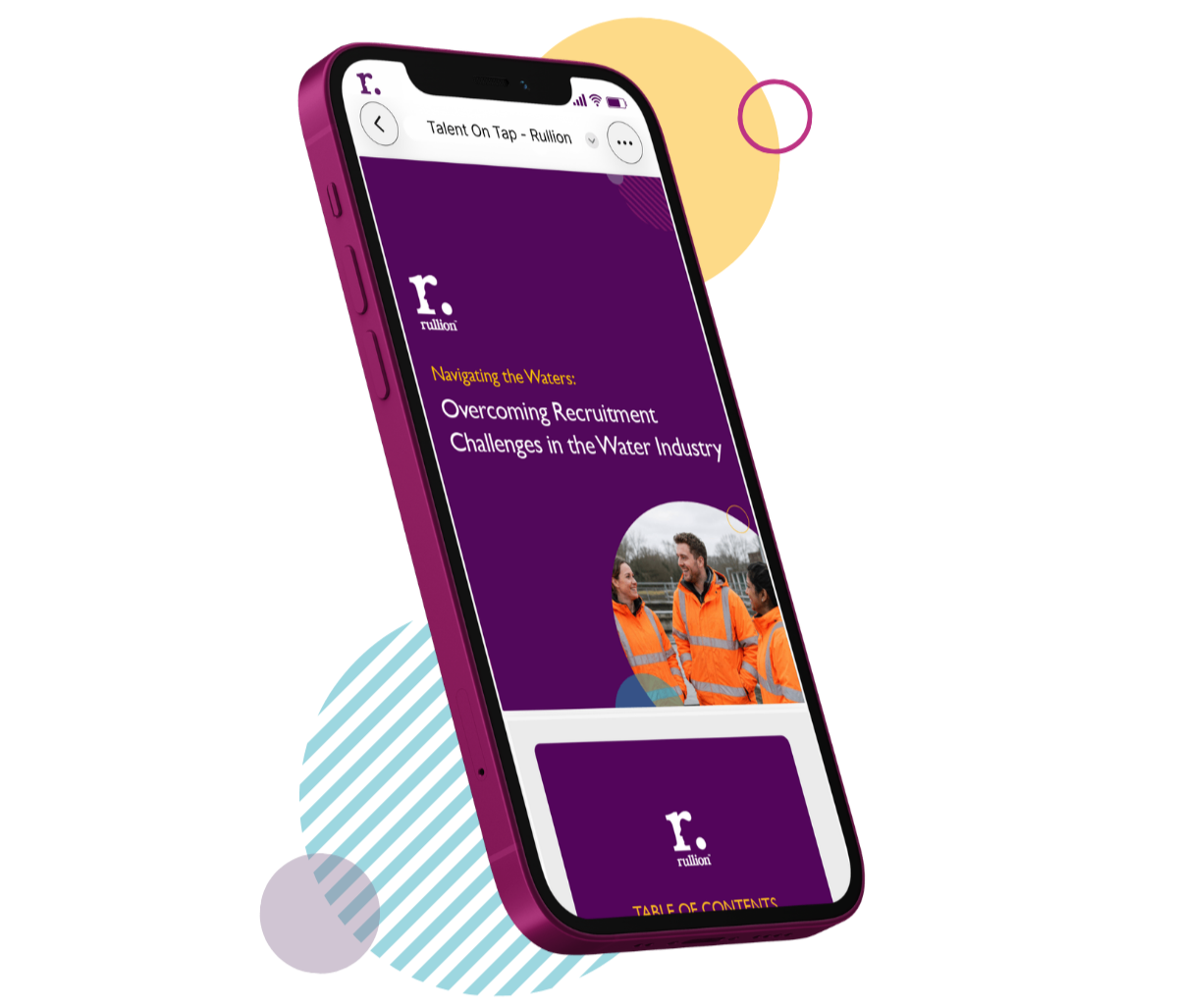
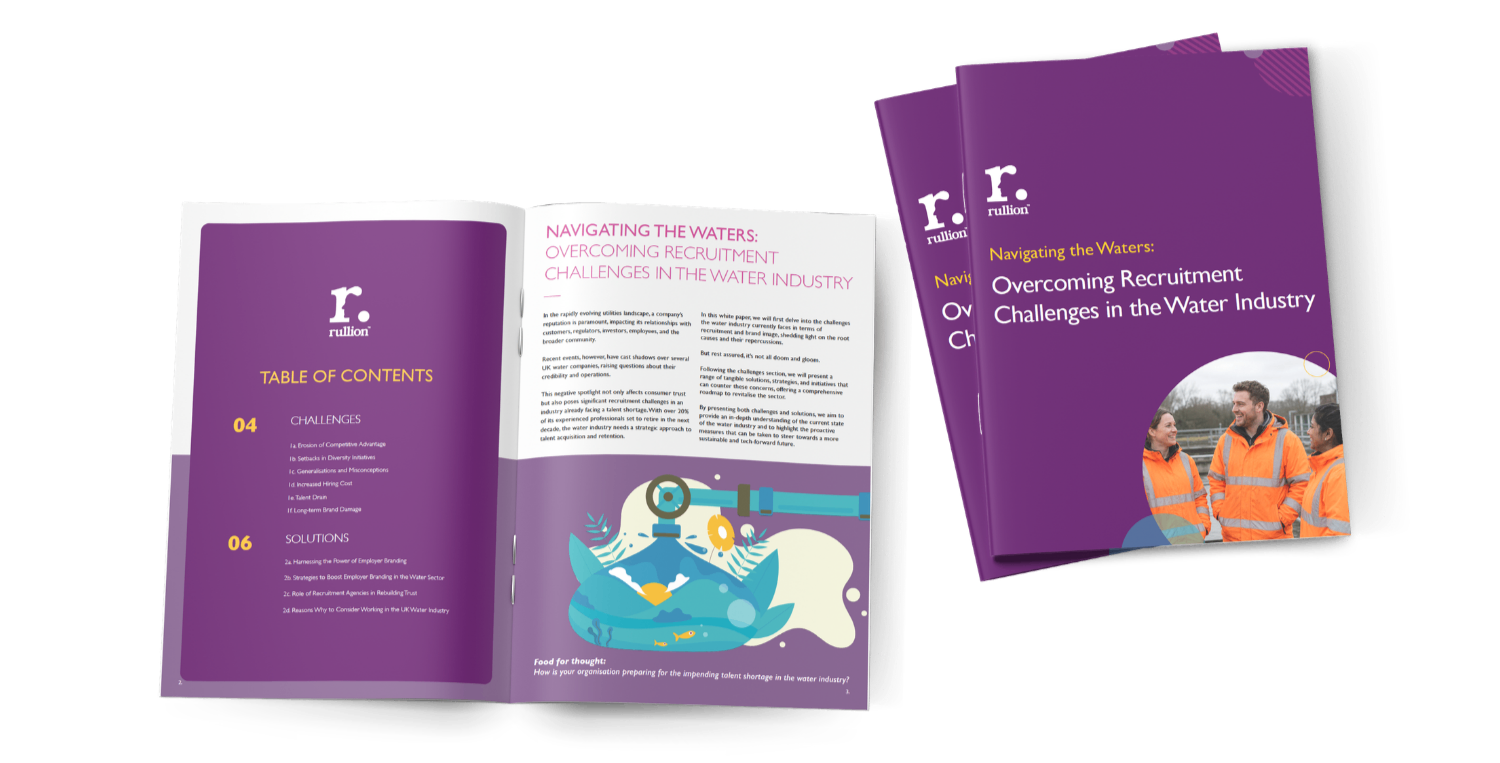
Water Industry Recruitment Challenges and How to Solve Them

Water industry recruitment pressures have been building for years. An ageing workforce, too few younger people coming through the ranks, and the reputational damage caused by recent industry scandals have all made it significantly harder to attract the right talent. With more than 20% of experienced professionals set to retire within the next decade, the water sector cannot afford to stand still.

This free guide from Rullion breaks down exactly what's driving the crisis in water industry recruitment and what water companies can do about it.

The reputational hangover is costing you candidates

Research shows that negative press has three times the impact of positive coverage, and for water companies already operating under public scrutiny, that asymmetry is playing out directly in the talent pipeline:

  • Fewer younger candidates are considering the sector at a time when workers under 24 make up just 8% of the workforce
  • Diversity pipelines are narrowing despite water companies making EDI a priority
  • Existing employees are quietly reconsidering their options as scandals continue to make headlines

What makes this particularly difficult is that candidates aren't always distinguishing between specific companies and the sector as a whole, meaning organisations with strong records are still feeling the effects.

Employer branding isn't a nice-to-have anymore

The antidote is a strong employer brand. This guide sets out ten practical employer branding strategies developed specifically for water and utilities workforce planning, including:

  • Taking control of your company narrative before the media does it for you
  • Building transparency into how you communicate with both candidates and existing staff
  • Using employee voices and community engagement to rebuild trust from the ground up
  • Identifying where continuous learning and career development can become a genuine differentiator


"Resilient companies face challenges and adapt. With the right team and approach, they can use these challenges as opportunities for growth." - Lindsay Harrison, Chief Customer Officer, Rullion

Water industry recruitment agencies can do more than fill roles

Most water companies use recruitment agencies to fill vacancies. Fewer people think of them as strategic partners in rebuilding how the sector is perceived. For HR leaders and talent acquisition teams working in a constrained environment, that shift in thinking can open up workforce solutions for utilities that wouldn't otherwise be on the table. This guide makes the case for that broader relationship, looking at how specialist utilities recruitment agencies can support:

  • Talent acquisition that goes beyond CVs to find candidates who genuinely align with your values
  • Employer brand campaigns that reach the right candidates in the right places
  • Training and development initiatives that address skills gaps before they become operational problems
  • Reputation management that helps water companies manage negative press and reframe the conversation

The water sector has a stronger proposition than most people realise

Underneath the headlines, water industry careers offer something genuinely rare. Meaningful, technically complex work in a sector investing heavily in AI-driven infrastructure, smart water management, net zero technology, waste-to-energy innovation and the kind of large-scale environmental projects that few other industries can offer.

It's also a sector where the pipeline of work is significant. Rullion has direct experience supporting water companies through the demands of AMP 8 delivery.

The guide closes with the five strongest arguments for why water is a compelling destination for engineering, environmental science and digital talent and how to communicate those arguments persuasively to the people you're trying to reach.

Download the full Talent on Tap guide

Written by Rullion's utilities recruitment specialists, this is a practical resource for senior HR, talent and operational leaders in the water sector who are thinking seriously about where their workforce is heading.

<h2>Download the full <span style="color: rgb(189, 51, 131);">Talent on Tap</span> guide</h2>

Have a utilities workforce challenge keeping you up at night?

Every water company's situation is different. Book a discovery call with Rullion's utilities recruitment specialists and let's work out the right approach for yours.

What's on your mind?

Our insights and tips on some of your most burning questions

NEWS
Nova Workforce Solutions launches to simplify how external workforces are managed across nuclear, utilities and transport

Nova Workforce Solutions launches to simplify how external workforces are managed across nuclear, utilities and transport

Rullion and Allegis Global Solutions announce the launch of Nova Workforce Solutions, the result of an alliance between both organisations that introduces a new unified model designed to simplify how critical infrastructure organisations buy, manage and deliver external workforces and outsourced services. Created to address a long-standing gap in the market, Nova Workforce Solutions gives medium-to-large nuclear, utilities and transport organisations a single, consistent way to manage contractors, temporary labour, specialist suppliers and outsourced services. The model is particularly suited to critical infrastructure organisations where complex supply chains, large workforces, specialist skills demand and delivery risk require a more joined-up approach. Many organisations have historically had to choose between providers with strong workforce delivery expertise or those with established outsourced services capability. Nova Workforce Solutions has been designed to remove that compromise through one model, one route and one accountable approach. Its single front-door model routes each requirement to the right solution, helping reduce fragmentation and improve visibility, governance and decision-making across workforce and services spend. The launch comes at a time of significant long-term investment in energy, transport and national infrastructure, with governments and private enterprise committing substantial capital to modernisation, resilience and net zero programmes over the coming decade. With spend, value and efficiency high on the agenda for procurement and business leaders, Nova Workforce Solutions is designed to help organisations unlock up to 20% cost optimisation opportunities across the external workforce. Nova Workforce Solutions is already supporting delivery within a multinational energy business, demonstrating the model in a complex and controlled environment. Commenting on the launch, James Saoulli, CEO of Rullion and Founder of Nova Workforce Solutions, said: “The requirements from an MSP have evolved for critical infrastructure organisations. They realise value through managing the entire extended workforce, including highly specialised contingent workers and services providers under Statement of Work arrangements.   Organisations operating in these environments have historically had to compromise by choosing either deep sector experts, or organisations with the scale, breadth, governance, and data capabilities to deliver a world‑class MSP and services procurement. The reason Nova Workforce Solutions is such a bright idea is because it eliminates the need for compromise and offers organisations within critical infrastructure the best of both worlds.” Simon Bradberry, Vice President for International Markets (EMEA and APAC) at Allegis Global Solutions, added: “The requirements from an MSP have evolved for Critical Infrastructure organisations. They realise value through managing the entire extended workforce, including highly specialised contingent workers and services providers under Statement of Work arrangements. Organisations operating in these environments have historically had to compromise by choosing either deep sector experts, or organisations with the scale, breadth, governance, and data capabilities to deliver a world‑class MSP and services procurement. The reason Nova is such a bright idea is because it eliminates the need for compromise and offers organisations within Critical Infrastructure the best of both worlds.” Nova Workforce Solutions will be showcased at the CWS Summit Europe in London in May 2026, where the alliance will meet buyers and industry leaders responsible for workforce, procurement and business transformation. For more information, visit novaworkforcesolutions.com.

By Rullion on 29 April 2026

BLOG
International Energy Agency's Energy Employment Report: What It Means for the UK’s Next Decade

International Energy Agency's Energy Employment Report: What It Means for the UK’s Next Decade

The global labour market is expanding rapidly. Employment in energy reached seventy six million people last year, growing at more than twice the rate of the wider economy. Clean technologies are now responsible for the majority of new jobs created. Solar, nuclear, grids, and storage are expanding employment at an unprecedented scale. The IEA captures this shift clearly, noting that “the electricity sector has become the world’s largest energy employer, driven by spectacular growth in clean energy investment.” Where many see constraint, the report points instead to a remarkable alignment of forces. Countries with the confidence to build training capacity, open new pathways and support people transitioning from adjacent industries are poised to capture long term economic, industrial and social value. For the United Kingdom in particular, this is not a story about scarcity. It is a story about potential. The UK has one of the most diverse industrial labour markets in the world, a deep engineering heritage, an increasingly ambitious clean energy programme and a workforce that is more mobile than ever before. With the right focus on development and reskilling, the UK can build the teams required for nuclear new build, offshore wind expansion, grid modernisation and clean transport at the pace needed. Rullion sees this opportunity clearly. Every day across nuclear, renewables, utilities and critical infrastructure, we see talented people ready to move, ready to train and ready to grow. The question is not whether the UK has the talent. It is how quickly we can build the pathways that unlock it. The Age of Electricity and the Rise of a New Workforce The headline figures of the report paint a picture of remarkable transformation. Global energy employment reached seventy six million people in 2024 and grew at more than twice the rate of the wider economy. The electricity sector has overtaken fuel supply as the largest energy employer for the first time in history. The IEA captures this shift clearly, stating that “the electricity sector has become the world’s largest energy employer, led by rapid growth in solar, grids and storage.” Solar power alone now employs five million people worldwide, while low emissions power has driven the vast majority of new roles created in the past year. The IEA calls this era the Age of Electricity. It reflects a structural shift that will define global energy systems for the next half century. As grids expand, renewables scale, and electrification replaces combustion in transport, heating and industry, human capability becomes the central currency of the transition. The technologies exist. The investments exist. The constraint is people. Yet the report also makes clear that this expansion is unevenly distributed. China dominates the manufacturing base for solar, batteries, heat pumps and other clean technologies. Emerging economies such as India and Indonesia are generating jobs at four to six percent annually. Advanced economies, including the UK, lag significantly behind. With older populations, more rigid labour markets and limited vocational throughput, they have seen energy employment grow at less than one percent. The IEA warns that “advanced economies face the slowest energy workforce growth and the most acute demographic pressures.” This imbalance exposes a strategic vulnerability. A nation that cannot produce the talent required to build and operate its own energy infrastructure becomes reliant on external supply chains and volatile global markets. It also becomes slower, more expensive and less competitive. The UK’s ambitions in nuclear new build, offshore wind, heat pumps, green transport and grid reinforcement depend on a workforce that does not yet exist at the necessary scale. A Workforce Expanding, Yet Straining at the Edges Nowhere are the tensions clearer than in the skilled trades. Electricians, welders, pipefitters, mechanical fitters and commissioning technicians represent the backbone of the energy system. These roles form more than half of the global energy workforce and are also where shortages are most acute. The report notes that “more than six in ten energy firms report persistent hiring difficulties, with applied technical roles the hardest to fill.” The construction boom across solar, wind, nuclear, grids and storage has created competition so intense that wages have risen sharply in many regions. Grid roles are especially constrained. Transmission and distribution now employ more than eight million people, yet growth is far below what electrification requires. The retirement profile is deeply concerning. The report emphasises that “between today and 2035, two out of every three new power sector hires will be needed just to replace retiring workers.” In advanced economies, the demographic imbalance is even more severe. These pressures manifest throughout the energy ecosystem. Manufacturing suffers from shortages in transformer specialists, switchgear technicians and high voltage cable jointers. Nuclear projects compete for the same welders and electricians required for offshore wind and defence. EV rollouts hinge on both digital skills and traditional trades. Even heat pumps, often discussed as a simple household retrofit technology, depend on retraining thousands of heating and HVAC engineers. When labour markets are this tight, delays become systemic. Project timelines lengthen. Costs rise. Productivity suffers. And the credibility of national energy strategies is placed at risk. Nuclear: A Sector Defined by Expertise and Threatened by Succession Among all energy subsectors, nuclear is the most exposed to demographic decline. Globally, the nuclear workforce is expanding, yet it remains one of the oldest and most specialised segments of the energy labour market. The report highlights the scale of the challenge, noting that “nuclear has the most severe ageing imbalance, with 1.7 workers nearing retirement for every young entrant.” For the UK, where nuclear new build is both a national priority and a cornerstone of future energy security, the implications are serious. Hinkley Point C has already demonstrated the scale of the workforce required for a gigawatt scale plant. Sizewell C will demand a similar or larger effort. Small modular reactors will require engineers with advanced competencies across digital control systems, materials science, reactor physics and high integrity construction. Defence nuclear and the emerging fusion sector compete for many of the same people, creating a labour congestion risk that the country cannot afford to ignore. The IEA points to France as an example of what can happen when maintenance capability and specialist expertise diminish, observing that “skill shortages have contributed to increased outages and reduced output in several advanced nuclear fleets.” This is a warning that the UK should take note of. Nuclear is a sector built on experience, precision and long cycles of talent development. Once expertise erodes, it cannot be regenerated quickly. If the UK is to deliver its nuclear ambitions, it must prioritise workforce planning with the same seriousness it applies to finance, regulation and site readiness. Electrification and the Emergence of New Talent Pathways Despite the severity of the challenges, the report contains a reason for optimism. Electrification does not only consume labour. It also generates new mobility across the wider economy. Manufacturing offers one of the clearest examples. Almost seventeen and a half million people in global vehicle manufacturing now work on electric vehicle technology. That shift has opened opportunities for workers with expertise in precision assembly, power electronics, automation and quality assurance. These skills transfer naturally into battery lines, grid equipment, robotics and advanced nuclear manufacturing. Heating engineers are moving into heat pump installation at growing rates. Aerospace and defence engineers are entering grid digitalisation, energy storage and fusion. Technicians and fitters from oil and gas are retraining into offshore wind, subsea cabling, hydrogen and large scale electrical integration. The IEA captures this shift succinctly, observing that “reskilling and cross sector mobility are now essential features of the energy labour market, driving new supply where traditional pipelines cannot keep pace.” This is one of the most encouraging findings of the report, because it demonstrates that the UK does not have a shortage of underlying talent. Instead, it has a shortage of structured, supported and scalable pathways that help people transition into energy roles. Pathways, not people, are the true constraint. The UK’s Workforce Challenge and Opportunity While the report groups the UK within the broader advanced economies category, its situation is distinctive. It is a mature energy system undergoing significant transformation. Nuclear new build, offshore wind expansion, grid modernisation, electric transport, solar growth and home retrofit programmes all overlap. They draw from overlapping labour pools, yet operate to different timetables and across different suppliers, contractors and regions. The UK’s workforce demographics compound the problem. The report notes that in advanced economies, “the number of workers approaching retirement is more than double the number of workers under 25.” That ratio is reflected across much of the British energy system. Vocational education output remains too low. And the occupations most vital to national delivery are the very ones most undersupplied: electricians, welders, commissioning engineers, cable jointers, plant operators and advanced technicians. Yet the UK also possesses one of the most diverse industrial bases of any advanced economy. Defence, aerospace, rail, automotive, manufacturing, construction and telecoms all hold talent that can transition into energy with the right support. These sectors form an untapped reservoir of capability, waiting to be unlocked. Building the Pathways: A Call to Action The IEA report offers a quantitative foundation for what UK employers already know. Labour is becoming the defining constraint of the energy transition. But this constraint is not inevitable. A nation can invest in vocational capacity, or it can accept undersupply. It can create mechanisms that promote reskilling, or it can allow other sectors to outcompete energy for talent. It can coordinate workforce planning across nuclear, renewables, utilities and transport, or it can allow programmes to clash and cannibalise one another. These choices will shape the next decade of UK industrial competitiveness. For employers, the conversation must shift from talent scarcity to talent creation. Experience and competence can be developed, but only when companies invest in structured training, early careers, cross sector transition and a change in hiring habits. For policymakers, investment in colleges, apprenticeships and regional clusters is no longer optional. For the UK, the costs of inaction will be measured not only in megawatts delayed or cost overruns absorbed, but also in lost strategic advantage. Rullion’s Perspective: Talent Is Not the Problem. Pathways Are. At Rullion, we see the reality of this challenge every day. Across energy and critical infrastructure, employers consistently report difficulty finding people. Yet when we look at the broader labour market, the potential talent is everywhere. It sits in sectors with transferable skills, in early careers populations who have never been exposed to energy as an option, in mid career workers seeking change and in communities eager for long term, well paid employment. This belief guides our models such as Train to Deploy. Instead of competing endlessly for the same small pool of candidates, we create the capability required for the sector, equipping people with the technical and practical skills needed to enter high demand roles. Our Early Careers teams bring young people into industries they might never have considered. Our cross sector programmes help workers transition from oil and gas, defence, aerospace, automotive and manufacturing into clean energy. We call this approach the Abundance Mindset. It is the belief that talent is plentiful when organisations are prepared to develop it, support it and welcome it. The IEA report reinforces this philosophy. The world is not short of electricians, fitters, technicians or engineers. It is short of ways to turn people into those professions. The Decade Ahead The World Energy Employment Report makes one conclusion unmistakable. The race for clean energy is rapidly becoming a race for talent. Capital will not be the limiting factor. Technology will not be the limiting factor. Workforce will be. For the UK, this is both a challenge and a remarkable opportunity. If we can change how we hire into roles, reform vocational education, scale reskilling, coordinate workforce planning and create genuine industrial clusters, it can not only deliver its energy transition but lead it. And if it builds the pathways, the people will come.

By John Shepherd on 12 December 2025

NEWS
Delivering Proven Screening Success at Hinkley Point C and Sizewell C

Delivering Proven Screening Success at Hinkley Point C and Sizewell C

Rullion has been a trusted candidate background screening provider since 2014, playing a vital role in supporting major UK nuclear new build infrastructure projects, including Hinkley Point C and Sizewell C. Working across multiple delivery partners and project phases, we’ve helped embed consistent, compliant, and candidate-friendly screening at scale. With over 8,000 candidates screened annually and clearance times reduced to an average of just 7.5 days, our model continues to support project momentum and onboarding efficiency - while maintaining the highest standards of compliance and governance. The Challenge To keep momentum on projects of this scale, pre-employment screening must be robust, accurate, and fast. Every individual working on site requires BPSS (Baseline Personnel Security Standard) clearance before work can begin. With multiple stakeholders, evolving regulatory requirements, and high volumes of candidates, the background screening process can be complex to manage, even with established systems in place. Our clients needed a nuclear screening provider who could bring clarity, consistency, and pace to an already demanding environment. What project teams need: Timely and accurate delivery of BPSS clearance and related vetting checks A positive, well-supported candidate experience Screening support delivered direct to projects like Hinkley Point C and Sizewell C, and across Tier 1 contractors and their supply chains Real-time visibility, control, and governance in screening processes Tier 1 contractors are the principal delivery partners on major projects such as Hinkley Point C and Sizewell C. Supporting them means enabling their workforces and suppliers to clear vetting efficiently, reducing risk of onboarding delays. A Proven Screening Model for Nuclear Environments Our nuclear screening model has evolved over years of delivery, working across early careers, agency-supplied workers, and permanent hires. The service model is grounded in best practice, with compliance and candidate experience at its core. Our solution is built on five key pillars: 1. Speed with Precision We consistently reduce average BPSS clearance times from 30-40 days to fewer than 8 days, using: A dedicated screening portal with automated timelines Electronic document collection via DocuSign One-to-one support from trained candidate advisors “We’re consistently achieving clearances in 7–8 days - and in urgent cases, we’ve turned around checks in just 24 hours,” says Jayne Lee, Head of Screening. 2. BPSS and Beyond We manage all core BPSS clearance elements: Right to work (RTW) Identity and address verification Criminal record checks (DBS) Three to five years referencing We also support CTC and SC clearance preparation where needed, compiling candidate packs ready for formal review. 3. Human-Led Candidate Experience Every candidate is assigned a named advisor who supports them through the screening journey; they answer questions, collect documents, and maintain engagement from start to finish. “We know how to reach the right contact for a reference. Our proactive approach keeps things moving,” adds Jayne. 4. Real-Time Governance Our clients benefit from full transparency throughout: Live dashboards and candidate status tracking SLA-based monitoring and escalation Monthly reporting and governance in screening audits 5. Scalable Across Supply Chains Our solution is used not only by project leads but by Tier 1 contractors across both Hinkley Point C and Sizewell C. The model scales to support different business units and workforce types including; contractors, agency workers, and permanent staff Impact to Date Over 8,000 candidates screened annually 75% reduction in average screening times +69 Net Promoter Score (NPS) from screened candidates BPSS compliance embedded with live audit capability Fully digital, mobile-friendly experience Adopted by Tier 1s across the project supply chain A Benchmark for Nuclear Screening Rullion’s screening model is now a recognised example of best practice in regulated environments, supporting complex infrastructure programmes where delays and drop-offs can have significant impact. We continue to support project teams across Hinkley Point C and Sizewell C, delivering the confidence and control they need to move quickly and compliantly. If you’d like to explore how our model could support your screening processes, get in touch with our team. Curious about common pitfalls? Read our guide on pre-employment screening mistakes.

By Rullion on 18 September 2025