Exploring purpose-led water industry careers

BLOGBy Rullion on 28 May 2026

Careers in the water industry are not always the first place candidates look when they start thinking about purpose-led work. But they should be.

There is a gap that sits quietly in the middle of many careers. The work pays the bills and the role is fine on paper. But somewhere underneath the routine, there is a question that does not quite go away: does any of this work actually matter?

For a growing number of younger professionals, salary alone no longer drives their career decisions. For Gen Zs and millennials, meaningful work, work-life balance, and a sense of purpose now sit alongside pay as major factors in how they judge employers and career moves. And yet the sectors that get associated with purpose-led work remain a fairly short list: healthcare, education, the third sector, and renewables.

The water industry rarely makes that list. And it should. If you are exploring water industry careers for the first time or reconsidering a sector you had already written off, it’s worth taking a second look. 

Jump to:


What does having a purpose-led career actually mean? 

“A purpose-led career” has become a phrase that can stretch to cover almost anything, which means it is sometimes vague enough to risk meaning very little. But at its simplest, a purposeful career means your daily output connects to something beyond the business itself. Beyond a company's commercial objectives, there is a positive impact on wider communities and the natural world.

Purpose lives inside any sector where the work is essential and the people doing it understand the difference their contribution makes. The water industry sits squarely in that. The question is why so few candidates are looking there.


The water sector has a perception problem

It would be dishonest to write about water industry careers without addressing the obvious. The sector has had a difficult few years in the public eye, from untreated sewage discharges and high-profile financial difficulties to criticism of executive pay, ageing infrastructure, and concerns about whether the system can keep pace with demand.

These issues have formed how many people outside the sector see it. 


Here’s what doesn’t often make the headlines:

The utilities sector is now being held to higher public standards than at any point in recent memory. The Water Industry (Special Measures) Act 2025 gave Ofwat and the Environment Agency stronger enforcement powers, including the ability to block executive bonuses at underperforming companies. Within the rule’s first year of the operation, Ofwat blocked more than £4 million of executive bonuses. This supports the continued focus on transparency and accountability across the water industry.

Then there is AMP8. The 2025 to 2030 asset management period represents the largest capital investment programme in the history of the English and Welsh water sector, with approximately £104 billion approved by Ofwat. The people being hired in the near future will help deliver and commission water infrastructure that communities will rely on for decades.

Curious about what that means for hiring across the sector? Our Talent on Tap whitepaper dives into the workforce pressures the water industry is up against as AMP8 delivery continues to ramp up.


The climate case for choosing a water industry career

For candidates drawn to environmental work, the water industry offers something many sectors struggle to provide: a direct connection between daily work and climate outcomes. Water scarcity, flooding resilience, catchment health, and river restoration are active priorities inside water utilities jobs. 

  • Catchment scientists are helping restore rivers degraded over decades
  • Environmental compliance engineers are reducing pollution incidents at source
  • Sustainability leads are designing net zero pathways for energy-intensive treatment processes
  • Hydrologists and engineers are delivering storm overflow remediation schemes
  • Ecologists, planners, and landscape specialists focused on nature-based solutions such as wetlands, sustainable drainage, and restored floodplains

What makes these careers meaningful is not just the environmental language around them. It is the fact that the outcomes are tangible: storm overflow schemes that reduce untreated discharges into rivers and coastal waters; wetlands and restored floodplains that help manage flooding and improve biodiversity; lower-carbon treatment processes; and infrastructure better equipped for a changing climate.

Supporting this, most major utility companies have made net zero commitments, with programmes covering renewable energy generation at treatment works, fleet electrification, sustainable drainage design, and embodied carbon reduction across capital projects. Continuing to show real impact for wider communities.


Community impact you can actually see

The scale of essential services is difficult to match. Water utilities serve entire populations. It creates a particular kind of professional responsibility that is difficult to replicate elsewhere. These programmes exist across the full breadth of the utilities sector, in urban and rural settings throughout England, Wales, and Scotland.

  • A treatment operations team monitoring water quality through the night so that millions of people can turn on a tap in the morning without thinking about it
  • A network planning team working to ensure pressure holds across a distribution system during a summer heatwave
  • A community engagement lead explaining a storm overflow improvement programme to residents who have watched their local river deteriorate for years

While investment and regulatory frameworks differ across the UK, utilities organisations nationwide are facing similar pressures. Take two examples: Scottish Water is publicly owned, while Dŵr Cymru (Welsh water) operates as a not-for-profit. Both reinvest the surplus into infrastructure and communities rather than distributing it to shareholders. That means value can be directed back into the network and communities they serve.

The innovation happening inside the water industry

One of the more persistent misconceptions about water industry careers is that the work is traditional in a way that leaves little room for innovation and the kind of technical challenge that attracts candidates from the more popular mainstream industries.

Water utilities are solving genuinely hard problems with emerging tools:

  • AI-driven leakage detection is reducing the volume of treated water lost through distribution networks
  • Digital twins of entire water systems allow engineers to model and test scenarios before committing to capital expenditure
  • Smart metering is generating large, complex datasets that need people who know how to work with them

Ofwat's innovation fund has been backing these initiatives through cross-sector collaboration and new approaches to network management and environmental monitoring, creating space for organisations to bring in methodologies from outside the sector. 

We’ve seen this firsthand through our work with the Northumbrian Water Group. Rullion’s involvement in the NWG Innovation Festival last year has given us a direct window into how utilities are bringing together engineers, technologists, and sustainability specialists to tackle challenges that don’t have an easy answer and are quietly doing some of the most interesting work in the sector.


The water industry is preparing for a generational shift

The water industry will see over 20% of its experienced professionals retire in the next decade. As innovation reforms how utilities are managed and the pressure on water infrastructure grows, the people who step into those roles will be defining what the sector looks like for the next generation. AMP8-focused capital programmes are already generating demand for data engineers and digital project managers alongside traditional civil and mechanical engineering roles. That demand is only set to grow.

For professionals considering a move from construction or energy, the translation is closer than it might appear. Embodied carbon reduction in infrastructure design and programme delivery under regulatory scrutiny are disciplines where experience from adjacent sectors is actively valued.


What roles exist in the water industry?

Water utilities careers span a wider range of disciplines than most people outside the sector realise, and it is worth mapping them out clearly. 

Operational and scientific

  • Water quality scientists
  • Treatment process operators
  • Catchment and environmental managers
  • Compliance specialists
  • Laboratory analysts

Engineering and capital delivery

  • Civil, mechanical
  • Electrical and process engineers
  • Capital delivery managers
  • Quantity surveyors
  • Project engineers

With AMP8 programmes running through to 2030, programme delivery roles are in sustained demand.

Digital and data

  • Data engineers
  • Network modelling specialists
  • Smart metering programme managers
  • Digital transformation leads

Environmental and sustainability

  • Net zero programme managers
  • Ecological advisors
  • Sustainable drainage specialists
  • Carbon analysts

Commercial, finance, and communications

Procurement, finance, commercial, and communications functions exist at scale across all major utilities, and experience built in other sectors transfers readily into them.

Early career pathways

Graduate schemes and degree apprenticeships are well-established entry points for early-career candidates, offering structured development alongside real delivery responsibility from the start.


How to start exploring a career in water

For candidates looking for work that combines long-term stability, technical challenge, and visible community impact, water industry careers may be worth considering. And the starting points are accessible:

  • CIWEM (the Chartered Institution of Water and Environmental Management) is the professional body for the sector, and a good source of industry insight, events, and career resources

  • Water UK represents the sector's major utilities and publishes workforce and investment data that gives a clear picture of where demand is concentrated

  • WaterAid and The Rivers Trust are worth exploring for candidates drawn to the international development or river catchment dimensions of water work

If you’re keen to explore further, the opportunities are already there. Water companies and their supply chains are hiring across engineering, environmental, digital, commercial, project delivery and operational roles. Vacancies are appearing on utilities careers pages, through specialist recruiters, and on major job boards. 

As a specialist recruitment partner in the utilities sector, we help candidates understand where their skills fit and which opportunities align with the kind of impact they want to make.

Share

Ready to explore water industry careers?

As a specialist utilities recruitment agency, we work with water companies and utilities employers across the UK. Browse our latest roles, or register your CV and we will reach out when something relevant comes in.
More like this

NEWS
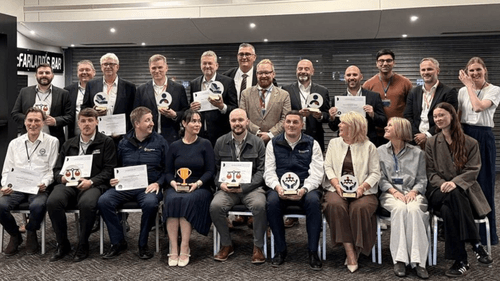
Rullion wins at 2026 Alstom Supplier CSR Awards

Rullion wins at 2026 Alstom Supplier CSR Awards

Rullion has been independently recognised by Alstom, one of the UK and Ireland’s largest rail organisations, for its work in protecting the health and wellbeing of people across safety-critical infrastructure. At Alstom's Supplier Corporate Social Responsibility Awards, held during its Supplier Day, Rullion won the Improve Health and Wellbeing Award for Large Companies. The awards recognise suppliers delivering meaningful social value across Alstom’s UK and Ireland supply chain, with entries judged by the customer teams who work closely with them. In its assessment, Alstom highlighted Rullion’s strong focus on preventing work-related ill health through robust risk management, as well as its understanding that wellbeing initiatives only make a lasting difference when they are supported by the wider culture. The feedback also described the breadth of evidence submitted by Rullion, including activity linked to an Alstom-hosted Inspire session. Wellbeing that supports real working lives At Rullion, supporting wellbeing is built into how we deliver workforce solutions rather than bolted on as a separate campaign. Our focus is on spotting pressure early, before it affects someone’s health and their safety on site, or the continuity of a client’s project. That means giving people consistent support, whether they are a permanent employee or a contractor working on a short-term assignment. Across the business, this is supported by trained specialists, practical manager guidance, and clear routes into help when someone needs it. This includes Mental Health First Aiders, I-ACT practitioners, our Wellbeing Warriors network, and partnerships with organisations such as Able Futures and Help@hand. In rail and other safety-critical environments, early support can make a real difference. Fatigue, stress, travel pressures, working patterns, and fitness-for-work concerns all need to be understood before they become a risk on site. This sits alongside the compliance frameworks rail employers already rely on, including RISQS and Sentinel, where workforce readiness and safety are closely connected. By staying close to people and giving managers the tools to respond, Rullion helps protect individual wellbeing while supporting safer, more reliable project delivery for clients. For clients, this joined-up approach helps protect individual wellbeing while supporting safer, more reliable project delivery. Supporting contractors in safety-critical environments Contractors are central to the UK rail workforce, often deployed on time-sensitive projects where compliance and site readiness leave little room for disruption. Rullion's role goes beyond placing people into roles. Our teams stay close to contractors across their assignments, so concerns surface early rather than at the point they affect a shift or a milestone. This means regular contractor engagement, proactive fatigue management, and direct conversations about travel, working patterns, medical compliance, and fitness for work. When we identify a risk, we work with the client to resolve it before it lands on site. Keeping contractors well and engaged is better for the individual, but it also supports the smooth running of large-scale programmes. A workforce that feels supported is more likely to remain prepared and able to work safely in demanding environments. A partnership shaped by shared standards This recognition is especially meaningful because it comes from a long-standing customer relationship. Alstom sees how Rullion operates day to day, and this award reflects the experience of the teams who work alongside us. It is also the second time Rullion has been recognised at Alstom’s Supplier CSR Awards, following our previous win in the Driving Equal Opportunity Award for Large Companies category. Being recognised twice, across two different areas, reflects Rullion’s wider role as a workforce partner committed to opening up access to opportunity and supporting the wellbeing of people across the rail supply chain and wider critical infrastructure programmes. Alistair Haigh, Executive Director at Rullion, said: “Being recognised by Alstom is a proud moment for us. Across critical infrastructure, supporting people well is fundamental to delivering complex projects safely and successfully. It is not a nice-to-have. This award reflects the care our teams show every day, supporting clients and contractors to create safer, healthier working environments. We're grateful to Alstom for the recognition and proud of the partnership we've built together.” Continuing to build healthier, safer workforces Workforce support has to hold up on-site, across depots, project sites and live safety-critical operations. Continuing to invest in wellbeing means helping people feel looked after while giving clients more stable, resilient, and engaged workforces. We sustain that by: Providing early support when concerns are identified Maintaining regular engagement with employees and contractors throughout their assignments Equipping managers with the guidance and tools to support their teams effectively Working closely with clients to promote safe, healthy, and sustainable working environments This is not only a rail story. It is part of Rullion’s wider role as a workforce solutions provider for critical infrastructure. In these settings, a well-supported workforce helps large-scale programmes move safely and reliably, with the people they need in place.

By Rullion on 28 July 2026

PODCAST
Why the ‘Nuclear Skills Gap’ Is the Wrong Conversation

Why the ‘Nuclear Skills Gap’ Is the Wrong Conversation

The nuclear skills gap is usually described as a shortage: not enough engineers, too few graduates, and a limited pool of people ready to support the next phase of UK nuclear delivery. But the nuclear skills gap may be the wrong starting point. The sector does need people urgently, but the bigger challenge is how we recognise and develop talent and connect them to the right opportunities. In that sense, the problem is not only a supply issue. It is also a hiring problem, a communication problem, and a workforce planning problem. Across the energy and nuclear sectors, the contradiction is hard to ignore. Employers say they cannot find the people they need, while early-career professionals and career changers are struggling to access roles they are capable of growing into. Demand is rising as the UK pushes ahead with nuclear new build, works towards net zero and plans for long-term infrastructure delivery. Yet the conversation is still often framed as a UK skills shortage, as though the only answer is to create more people with the right labels on their CV. That misses a more useful question. What if the talent already exists, but the sector is not always looking for it in the right way? Jump to: The skills gap narrative is too simplistic Careers aren’t linear, but hiring in nuclear still is Transferable talent is more prevalent than ever Why the future of work is reshaping what “job-ready” means in nuclear University isn’t the default route into nuclear careers How to close the skills gap in nuclear Adapting your workforce planning The skills gap narrative is too simplistic The phrase “skills gap” is useful because it creates urgency. It gives employers, educators, and policymakers a shared problem to rally around. But it can also flatten a much more complicated issue. When hiring teams talk about an employee skills gap, they often mean something specific: candidates are not arriving with the exact sector background or technical exposure listed on the job specification. In nuclear that caution is understandable. Safety, regulation, site knowledge, and procedural confidence all matter. However, when every vacancy is designed around a perfect match, the pool narrows before potential is even considered. Job descriptions can become filters rather than gateways. They reward people who already know how to describe themselves in nuclear language and discourage those whose expertise has been built elsewhere. That creates a disconnect between candidates and hiring managers. One side sees a role they cannot quite match. The other sees a CV that does not immediately translate. Miguel Trenkel-Lopez captured this neatly in his Hot Off The Grid conversation. Through Megawatt, Miguel has spoken to young people who say they have applied for roles and have been rejected despite having relevant skills. He has also spoken to companies who say they are trying to hire but cannot find people. His conclusion was blunt: “It’s not a skill shortage. It’s a communications failure.” This perspective changes the response the sector needs. If the problem is only a shortage, the answer is to keep pushing more people into the pipeline. If it is also a communication and translation problem, the sector needs to think beyond the skills gap and look at how talent is identified and developed. Careers aren’t linear, but hiring in nuclear still is Career paths have changed. People no longer move through one neat route from education to entry-level role and then specialist career. They build experience across different sectors. They move sideways and retrain. Or they discover an industry through advocacy, outreach, a graduate scheme, or a chance conversation. Hiring in nuclear has not always adapted at the same pace. Many nuclear roles are still assessed against linear criteria: a particular degree, a recognisable employer background, or a set number of years in a similar regulated environment. Those things may be relevant, but they are not the whole picture. When hiring models focus too heavily on direct experience, they risk missing candidates whose careers have given them the judgement, curiosity, discipline, and adaptability the sector needs. Yasmin Ali’s career is a useful example. She began in fossil fuel generation, including a coal-fired power station, before moving through gas, district heating, government, and clean energy. When she wanted to shift direction, recruiters tended to frame her by the role she had most recently done rather than the broader expertise she had built. She used her network to make the move, but not every candidate has access to that kind of informal bridge. That is one of the hidden weaknesses in current hiring models. They depend too heavily on candidates knowing how to translate themselves. In a complex sector like nuclear, that cannot be left to chance. Transferable talent is more prevalent than ever Between entry-level candidates and perfect-match hires sits a large group of overlooked people: transferable and adjacent talent. They may not describe themselves as nuclear candidates, but they often hold experience that could be highly relevant with the right assessment and development. Construction Large-scale infrastructure Manufacturing Energy & Utilities Defence Transport Major project delivery Compliance Safety Operations Regulated environments The barrier is rarely a total lack of ability. More often, it is that their experience is framed differently. A hiring manager may be looking for direct sector experience, while a candidate reads the same role and assumes they do not belong. If the search then relies too heavily on familiar keywords, people can be excluded before their potential is properly explored. This is particularly important for nuclear recruitment because the sector needs more than one kind of specialist. It needs engineers, but it also needs project managers, technicians, planners, safety professionals, commercial teams, supply chain expertise, communicators, and people who understand how large infrastructure programmes actually get delivered. The nuclear career opportunities are vast. The workforce required to build, operate, and maintain nuclear projects is wider than the public perception of the industry often suggests.A project planner from rail may already understand programme controls, stakeholder management, and how to work within complex regulatory frameworks. A safety professional from defence may have experience operating in highly controlled environments where compliance and risk management are critical. The underlying capabilities are often transferable, even when the sector terminology is different. Jens Christiansen’s route into nuclear shows how much difference exposure and connection can make. In Denmark, where nuclear power has long faced political barriers, he built his pathway through advocacy, university choices, networking, and an internship in Sweden. His story is not a neat linear funnel. It shows how interest becomes a career when people have access to the right guidance and opportunities. The lesson is clear. Talent may not always come from the expected source. The task for employers is to recognise talent earlier and create clearer routes into the nuclear sector. Why the future of work is reshaping what “job-ready” means in nuclear The expectation that candidates should arrive fully job-ready is becoming increasingly unrealistic. That is not unique to nuclear, but it is especially visible in a sector where the demand for specialised capability is increasing and experienced workers are retiring. There is a difference between 'job-ready' and 'development-ready' talent. A job-ready candidate can step into a role with minimal support. A development-ready candidate may not know every process on day one, but they have the underlying capability and adjacent experience to grow into the role with structured training and on-the-job exposure. Nuclear has always depended on learning in context. Site knowledge, safety culture, regulatory confidence, and procedural understanding do not develop through a CV alone. They are built over time alongside experienced teams, through real work. That means skills gap solutions cannot focus only on immediate vacancy fulfilment. They need to include long-term development routes, including train-to-deploy models, early careers support, mentoring, and clearer progression pathways. The sector cannot wait for fully formed talent to appear. It has to build the conditions for capable people to become nuclear-ready. University isn’t the default route into nuclear careers The previous conversation around nuclear education still matters. Universities play an important role in creating strong technical foundations, particularly for engineering and science roles. But they cannot be treated as the only answer. Young people are entering a much tougher employment landscape. Recent figures from the House of Commons Library put youth unemployment among 16 to 24-year-olds at 16.2%, at a time when infrastructure and energy employers are still talking about shortages. That should make the sector pause. If young people are struggling to access work while nuclear employers are struggling to hire, the issue is not only education. It is the bridge between education, awareness, and employment. Nuclear apprenticeships are part of that bridge. So are school outreach, early careers programmes, career-switcher pathways, and employer-led training. Daljeet’s story from the wider energy sector is a reminder that valuable careers do not always begin with university. She started as an apprentice, moved through customer operations and built a senior career in energy. As she put it, university is a good option for many people, but it is not the only option. That message matters for nuclear graduates too. The sector needs to make early career routes feel accessible and realistic. Not everyone will arrive already fluent in nuclear. The more important question is whether they have the potential to learn and contribute. How to close the skills gap in nuclear Closing the skills gap in nuclear starts with reframing the question. Instead of asking only, "Where are the people with this exact experience?" employers need to ask, "What expertise does this role truly require, and where else might that expertise exist?" That shift changes how roles are designed, how candidates are assessed, and how hiring teams think about risk. Job specifications need to focus more on outcomes than previous job titles. Transferable skills need to be mapped from adjacent sectors. Career pathways need to feel clearer for people who do not already know the industry. It also means treating nuclear workforce planning as a strategic activity and not a reactive response to vacancies. If employers know what expertise they will need in three, five or ten years, they can start building it now through apprenticeships, graduate programmes, train-to-deploy routes, redeployment, and cross-sector attraction. Adapting your workforce planning The nuclear workforce challenge is real, but it is not a simple absence of talent. It is a disconnect in how talent is defined and moved into opportunity. That is why the traditional model of matching people to jobs is increasingly misaligned with how nuclear careers actually develop. The industry needs a wider view of talent, one that recognises potential before it is packaged into familiar nuclear experience. For employers, the opportunity is significant. Better translation of skills means broader candidate pools, stronger retention and more resilient project delivery. For candidates, it means seeing a route into a sector they may previously have ruled out. The skills gap conversation is not wrong because skills do not matter. The skills gap is real. It becomes less useful when the conversation is limited to just the shortage. The better conversation starts with better routes into the sector. It also means recognising potential earlier and creating a workforce strategy that reflects how people are building their careers today. The UK’s and Europe’s nuclear ambitions will ultimately depend on people. And not just those already working in the sector. Those who could be, if given the right opportunity. To hear more conversations from across the nuclear and other critical infrastructure sectors, explore our Hot Off The Grid podcast series.

By Rullion on 01 July 2026