
Rullion Awarded the Driving Equal Opportunity Award for Large Companies by Alstom UK & Ireland

NEWSBy Rullion on 30 May 2025

Rullion Awarded the Driving Equal Opportunity Award for Large Companies by Alstom UK & Ireland 

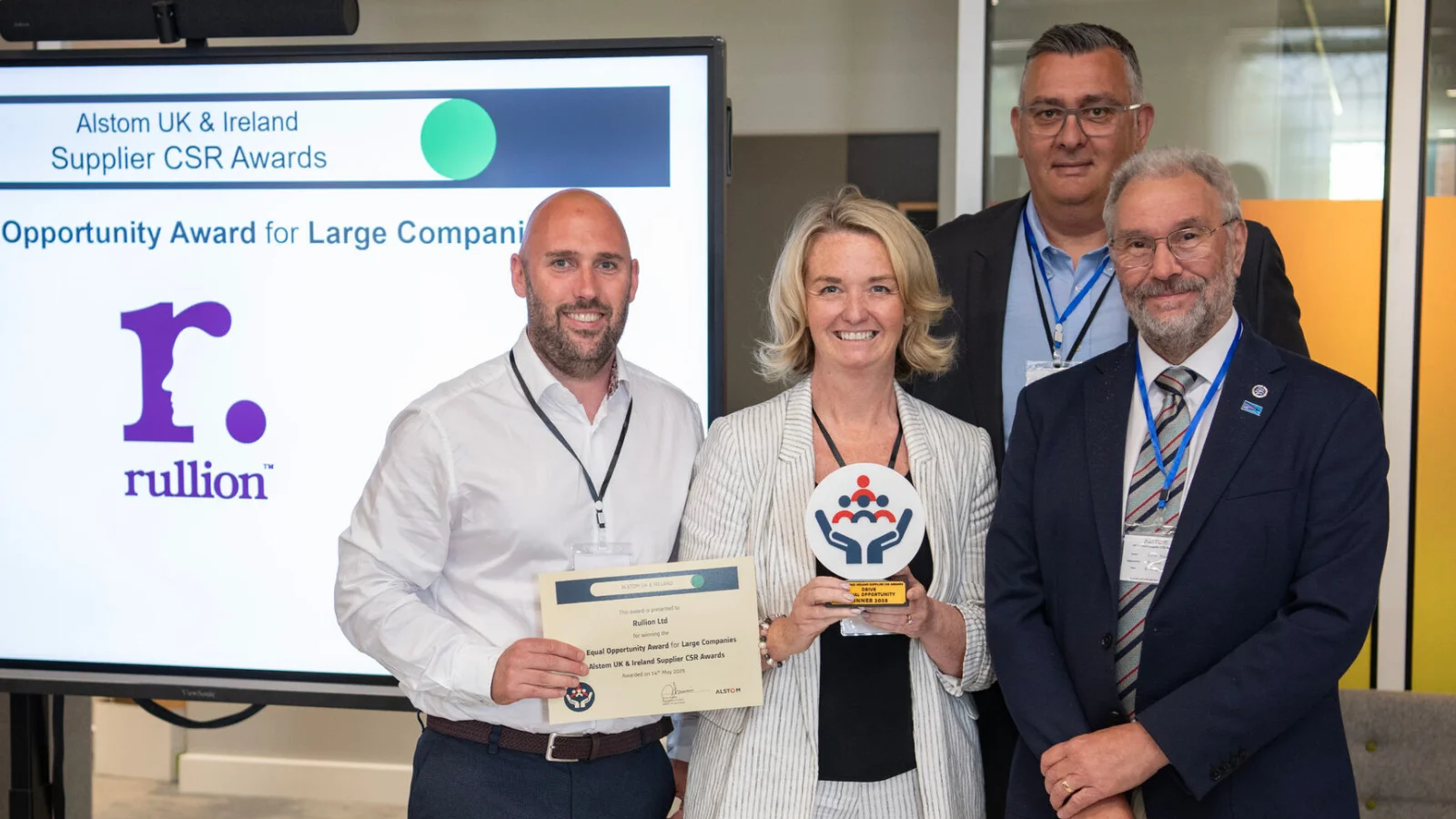
This month (May 2025), Rullion has won Social and environmental impact of rail supply chain recognised in Alstom’s Supplier CSR awards in the UK and Ireland | Alstom. This accolade recognises our data-driven ED&I partnership in rail. This partnership combines aligned values with hands-on action to implement an effective inclusive hiring strategy. This recognition celebrates the power of aligned values, practical action, and a shared vision for the future of inclusive hiring. 

With over 6,000 employees and 37 sites, Alstom is the UK and Ireland’s leading provider of new trains and train services. Beyond their rail expertise, they are champions of equity, diversity, and inclusion (ED&I) in the transport industry. These values resonate deeply with our team at Rullion. 

As the industry navigates new technologies and changing workforce demographics, having flexible and innovative workforce solutions for industries like Rail and Transport, is essential to attracting, developing, and retaining top talent.  

This award is more than a milestone for us. It celebrates the collaborative effort shaping a more representative workforce across critical infrastructure. Creating an inclusive workplace requires more than good intentions. It requires action. 

Lindsay Harrison, Chief Customer Officer at Rullion: 
“On stage at the award ceremony, I spoke about breaking down barriers and today I’m proud to see Rullion and Alstom doing exactly that, every day.” 

Why This Award Matters  

Winning Alstom UK & Ireland’s Driving Equal Opportunity Award demonstrates how our data-driven ED&I recruitment partnership delivers measurable impact on diversity in rail, setting a new standard for inclusive hiring pipelines. 

From day one, our partnership with Alstom has been rooted in mutual trust and a shared belief that diverse teams create stronger businesses and better outcomes. 

We are proud to work alongside Alstom because of their authentic, values-led approach to ED&I. Whether it is supporting the Women in Rail Awards, embedding inclusive behaviours at every level, or aligning their workforce with the communities they serve, they lead by example. Alstom’s belief that diversity is key to innovation and long-term success is something we live and breathe at Rullion as well. 

That is what makes this award so meaningful. It recognises not just what we have done, but how we have done it together. 

Monitoring with Purpose, Protecting Privacy 

Understanding representation begins with the right data. However, how data is used matters just as much as what data is collected. 

At Rullion, we track ED&I data for both permanent staff and contractors - covering gender, ethnicity, age, disability, sexual orientation and religion. To safeguard privacy, we group insights by function or business unit rather than individual job title. This approach uncovers trends without risking confidentiality.  
 

We track ED&I data for both permanent staff and contractors, covering gender, ethnicity, age, disability, sexual orientation, and religion. To safeguard privacy, particularly in niche roles often held by only one or two individuals, we group insights by function, business unit, or client programme rather than individual job titles. This method ensures that the insights are useful while keeping identities anonymous. 

This approach allows us to identify patterns, address gaps, and measure progress over time. It empowers us to act with intent while protecting the privacy of those we support. 

As Liz, our ED&I Lead, puts it: 
“Our strength lies in blending data-led insights with real empathy. This award proves that when we partner purposefully, we make lasting change.” 

We apply the same rigorous standards internally. Recently, we introduced diversity monitoring across our recruitment processes, tracking candidate data from application to offer. This gives us a clear view of how inclusive our hiring journey is at every stage. 

Already, we’re seeing actionable insights - from application rates to conversion patterns - that help us identify barriers and implement targeted improvements. 

With clients, we go even further. Using our CRM system, we track ED&I data throughout the contractor lifecycle. For organisations like Alstom, we’ve developed bespoke Power BI dashboards that reveal real-time trends across gender identity, ethnicity, disability, and more. All data is anonymised and fully aggregated. 

But this isn’t data for data’s sake. 
 
We combine insights with quarterly reporting and practical recommendations, from inclusive attraction strategies to accessible job descriptions and interview support. It’s about making recruitment better for everyone. 

 
A Tailored, Client-Centric ED&I Partnership Model 

Our partnership with Alstom combines real-time diversity dashboards, quarterly data reviews and joint action plans - ensuring every rail project recruits talent that reflects the communities we serve. 

Every client we work with has different ED&I goals. For some, it is about boosting gender diversity in technical roles. For others, it is about creating more pathways into leadership for underrepresented groups. That is why we never take a one-size-fits-all approach. 

Instead, we align with each client’s specific reporting standards, terminology, and strategic aims, all while ensuring data handling remains ethical and GDPR-compliant. 

With Alstom, that partnership model has come to life. From day one, we have worked together to build a data strategy that fits their operational needs and reflects their values. Real-time dashboards help track progress. Our recruitment insights shape decisions. Regular reviews help ensure progress stays on track. 

That is what inclusive delivery looks like: collaborative, flexible, and grounded in real-world action.
 

Partnership in Practice: Collaborating With Alstom 

What makes our partnership with Alstom stand out is its clarity of purpose. Together, we have taken steps that go beyond compliance. We shape recruitment strategies, remove barriers, and improve representation across their contractor population. 

From creating real-time dashboards to tracking candidate demographics, suggesting tangible changes in hiring workflows, and proactively recommending inclusive attraction methods, it is a truly collaborative effort. It has had measurable impact. 

We have seen improvements in application diversity, candidate progression, and feedback from underrepresented groups. We have worked together to open doors and keep them open. 

We are not stopping here. Our partnership with Alstom is ongoing, evolving, and focused on what is next.

Meet Our ED&I Engine: The Rullion Musketeers 

Inclusion starts at home. And at Rullion our ED&I Musketeers make inclusion part of everything we do. 

Since 2021, this volunteer-led workstream has driven our internal ED&I strategy. From coordinating awareness days and designing training resources to gathering colleague feedback and driving cultural change, the Musketeers keep inclusion front and centre. 

It is not about grand gestures. It is about sustained, everyday action that makes people feel seen, respected, and supported. 

Here is what we have achieved so far: 

  • In 2021 and 2022, we rolled out our first company-wide ED&I survey, launched the ED&I Resource Centre, and aligned monthly activity with national awareness days across race, gender, and disability. 

  • In 2023 and 2024, we earned Disability Confident Level 2 status, reinforcing our commitment to accessible and inclusive work environments. 

  • In 2024 and 2025, we focused on neurodiversity and social mobility, including dedicated campaigns, learning resources, and a more inclusive approach to internal recruitment. 

These efforts feed directly into our ED&I 2025 Plan, which outlines clear goals across recruitment, communications, employee engagement, and external partnerships. 

What’s Next for Rullion & The Rail Sector 

Being recognised with the Driving Equal Opportunity Award by Alstom is a huge honour.  

It shows what is possible when shared values and practical action come together. It reminds us that the work does not stop. There is still more to do, more to learn, and more barriers to break down. 

We are proud of the journey so far and excited about what comes next, not just with Alstom but with every organisation that shares our vision of a more inclusive future. 

Because inclusion is not a trend. It is the foundation for what comes next. 

Gareth Smith, Client Services Manager - Alstom: 
“Winning this award with Alstom shows that inclusive recruitment is not just a nice-to-have, it is necessary to drive productivity on every rail project we collaborate on.” 
 

Ready to build a more inclusive, data-driven recruitment strategy? 

Let us talk about how we can support your ED&I goals and help you create a workforce that reflects your values and communities. 

Contact us today to start the conversation. 

Share

More like this

BLOG
How is MHHS impacting the energy workforce?

How is MHHS impacting the energy workforce?

For several years, industry planning has included the Market-wide Half-Hourly Settlement (MHHS) as part of the larger UK energy market reform. The deadline for May 2027 remains in place, and with central systems achieving readiness in 2025, meters are now being integrated into the new settlement model. To continue operating under the current settlement arrangements, organisations are currently figuring out how to integrate their current platforms into the MHHS infrastructure. Jump to: MHHS reaches far beyond settlement Where programmes are feeling the strain How hiring conversations are evolving Broadening where capability comes from Preparing for MHHS workforce demand MHHS reaches far beyond settlement The majority of the definitions surrounding MHHS emphasise the transition from estimated usage to precise, half-hourly readings. That description merely reflects the result. The underlying shift is how this change in settlement is supported. Electricity consumption is measured every 30 minutes based on actual data, not on profiles or estimates. Systems designed for periodic updates now need to handle continuous streams of information, with far less tolerance for delay or discrepancies. Data flows between organisations and needs to stay consistent at every stage to prevent errors in settlement. This is where energy system integration becomes essential. As information no longer sits within a single platform or team, effective coordination is required across independently managed systems, each presenting unique constraints around data formats, settlement timings, and the validation processes prior to submission. The act of consumption itself evolves into a more dynamic experience. Metrics like average household electricity consumption or average UK home electricity consumption are no longer fixed reference points. Data collected every half hour reveals how usage varies throughout the day, directly influencing forecasting models and operative decisions. Where programmes are feeling the strain MHHS programme teams are scaling while still working through the intricacies that only emerge as systems begin interacting. Dependencies between internal platforms and central MHHS infrastructure are becoming clearer during testing, where data needs to be exchanged, validated, and accepted within defined time windows. Data handling stands out as a significant pressure point. Half-hourly settlement depends on precise, high-frequency data streams, which existing systems are not always designed to support. In many cases, such pressure leads to projects for reworking parts of the architecture instead of simply building upon existing infrastructure. Especially relevant where data infrastructure and quality have been identified as potential risks within the transition to MHHS. The settlement and billing processes still need to function smoothly, even as new strategics are introduced and tested alongside them. This means operational teams are working within both models at once, adding to the existing workload for processes that already depend on a small pool of specialists. How hiring conversations are evolving With the rise in delivery activity, demand for specific skillsets is becoming easier to pinpoint. There has been a noticeable uptick in hiring for programme leadership, data engineering, and settlement expertise. Roles focused on data governance and system integrations are also gaining traction as organisations move further into managing migrations and various phases. How those roles are defined is starting to influence how quickly they can be filled. Some roles heavily rely on hiring criteria based on prior experience in the energy market, which can unexpectedly limit the candidate pool. As a result, roles frequently stay open for extended periods or fill at a slower pace than programme timelines permit. This places additional pressure on existing teams and slows progress in areas where specialist expertise is already stretched Many of the required capabilities are not exclusive to the energy sector, although they are frequently presented that way during hiring processes. Some organisations are already adjusting how they approach these challenges. Rather than focusing only on direct sector experience, they are bringing in people who have delivered comparable programmes in other environments. Broadening where expertise comes from Financial services platforms handle high volumes of transactional data, making accuracy, reconciliation, and auditability essential. Telecoms programmes oversee infrastructure transformation throughout distributed networks, often coordinating system upgrades while minimising interruptions to live services. In large technology environments, integration teams routinely connect platforms with different data structures, handling mismatches in format, latency and validation rules. These examples align closely to the types of challenges encountered in MHHS delivery: Data engineers who have honed their skills with high-volume transactional systems can apply that expertise to half-hourly data flows. Data governance specialists bring experience in managing data quality and resolving validation exceptions where information does not meet required standards. Programme managers who are used to coordinating complex infrastructure or digital programmes are well-versed in managing dependencies across multiple teams and timelines. Integration specialists often move between sectors, applying their expertise to connect systems that were not originally intended to work together. Transitioning into the energy sector still requires onboarding and familiarity with the operating environment. However, they allow organisations to access capabilities that would otherwise fall outside conventional hiring standards without causing additional delivery delays. There is also increasing interest in structured development routes. Training programmes are being used to build skills in areas experiencing increased demand during phases like testing and migration and the transition into live systems. Preparing for MHHS workforce demand Workforce planning needs to adapt and evolve with the MHHS programme rather than sit alongside it. Each phase presents its own unique set of requirements. Mapping these changes in advance helps reduce reliance on reactive hiring, especially in areas where onboarding takes time. This also allows for different ways of structuring delivery. Some roles are better suited to permanent teams. Others can be delivered through specialist contractors or outcome-based models depending on the nature of the work. Align workforce planning to delivery phases MHHS delivery doesn’t place consistent pressure on the same roles throughout. Workforce demand shifts as programmes move forward, and planning needs to reflect that progression rather than treating hiring as a single, static requirement. In the early stages, work tends to centre around architecture and settlement design. Solution architects define how systems will connect and business analysts translate regulatory requirements into process and system changes. Settlement specialists are also closely involved here, reworking existing processes and identifying where adjustments are needed. As programmes move to system integration testing (SIT), demand shifts. The emphasis moves from design to validation, with data engineers and integration specialists becoming more central as data moves between systems and needs to hold up under settlement conditions. Bringing these systems together safely requires the expertise of both the test managers and environment leads to ensure seamless coordination. The later stages bring different pressures. The rise in migration activity drives a greater need for professionals skilled in data alignment and reconciliation to make sure records match across systems. Operational teams tasked with billing and settlement processes are gearing up to implement innovative strategies while maintaining existing processes. Some roles require continuity where knowledge of settlement processes needs to be retained. Others are more concentrated within specific phases. By structuring workforce delivery around these stages, organisations can bring in support where needed, without the need to expand teams across the entire programme. Delays tend to surface once systems interact at scale Successful integration hinges on coordination across teams working within defined settlement timelines. Delays in one area can quickly affect others. Migration then adds further pressure. Transferring meters and associated data into the new model demands both continuity and accuracy. When additional support is not in place early enough, existing teams absorb the extra workload, which can hinder progress and raise the chances of errors in settlement outputs. MHHS delivery depends on how teams are built MHHS sits within a wider energy market reform, with multiple organisations in the sector progressing through delivery at the same time and often drawing on the same types of experience. The overlap is already influencing the speed of team construction and the onset of progress slowdowns. Identifying these overlaps earlier allows organisations to bring in the right experience before timelines are affected. Once programs reach the integration or migration stages, there is less flexibility to resolve gaps without slowing delivery. This is why workforce delivery is starting to shift. Delivery is less about the technology itself and more about the teams having the right capacity and expertise in place to carry programmes through. Broadening the methods of talent assessment and exploring new avenues for sourcing talent, including bringing in transferable skills from adjacent sectors, can enhance MHHS delivery. The organisations that move with more certainty here tend to be the ones that have built teams to be able to handle the complexity and scale of the change required.

By Rullion on 15 April 2026

NEWS
Rullion joins Energy & Utility Skills to support workforce planning

Rullion joins Energy & Utility Skills to support workforce planning

The UK’s energy and utilities sectors are preparing for a level of infrastructure investment that will require more than 300,000 new workers over the next five years. That challenge is not just about attracting more people into the sector. It is also about how organisations understand the workforce they need, how they access it, and how workforce planning connects to delivery in practice. As investment accelerates, workforce pressure is building across multiple fronts at once. Skills shortages remain well documented, but the challenge extends beyond supply. It also includes visibility, coordination, and the ability to plan across increasingly complex delivery models. Across infrastructure programmes, delivery relies on a mix of permanent teams, contingent labour, specialist contractors, consultancies and supply chain partners, often operating across different stages of the same programme. Workforce planning needs to reflect that reality, rather than focusing solely on traditional headcount. Rullion has joined Energy & Utility Skills  as part of this wider industry focus, contributing a distinct perspective as the only workforce solutions provider in the membership, with insight into how workforce strategies can better reflect the realities of delivery. Why Rullion has joined Energy & Utility Skills Energy & Utility Skills plays a central role in supporting workforce development across the energy, water and waste sectors. Through industry collaboration, workforce research and skills strategy, it brings together employers, partners and policymakers to address long-term capability challenges across critical infrastructure. Rullion has joined as part of that wider effort, contributing practical insight from across the extended workforce. While much of the industry focus is on attracting new entrants and developing skills pipelines, a significant proportion of delivery continues to rely on contingent labour, specialist contractors and external delivery partners. Bringing greater visibility to that part of the workforce, and how it interacts with permanent teams, is an important part of building a more complete view of workforce capability. James Saoulli, CEO at Rullion shared: “We’re proud to join Energy & Utility Skills and to be part of a community focused on addressing one of the sector’s biggest challenges - building a skilled, resilient workforce for the future. As investment accelerates across the energy, water and waste sectors, we believe there is a real opportunity to take a more integrated approach to workforce planning, bringing together both permanent and extended workforce models. We look forward to working with Energy & Utility Skills and its members to support the delivery of the UK’s net zero ambitions.” Workforce planning needs a broader view Much of the workforce challenge sits in the gap between the workforce organisations plan for and the workforce they actually rely on to deliver projects. These programmes are delivered through a combination of permanent teams, contingent workers, specialist contractors and wider delivery partners. Not all of that workforce is equally visible in planning discussions, despite playing a critical role in delivery. This is already becoming more visible across the sector, as organisations respond to growing pressure around hiring, skills access and delivery timelines. While the industry has spent years focused on decarbonisation targets, energy security and affordability are now accelerating investment and infrastructure upgrades. We explored this further in our recent piece on UK utilities hiring challenges employers cannot ignore in 2026. A more complete view of workforce demand allows organisations to plan with greater accuracy, particularly where delivery models are layered, timelines are long, and competition for skills is increasing across the market. Bringing insight from delivery environments Rullion brings more than 45 years’ experience supporting organisations across energy and utilities, working alongside companies including EDF Energy, E.ON and Northumbrian Water. That perspective comes from the delivery environment itself. Across major infrastructure programmes, workforce challenges rarely sit neatly within one hiring channel. They tend to emerge across the interaction between permanent teams, contingent labour and external delivery partners. This is where greater workforce visibility becomes important. Understanding where capability sits, how it is being deployed, and how different workforce models support delivery gives organisations a stronger basis for workforce planning. It also helps widen the conversation around skills. Not just in terms of how many people are needed, but how workforce capability is built, accessed and coordinated over time. A more joined-up approach to workforce capability Energy & Utility Skills plays a central role in helping the sector respond to long-term skills and workforce pressures across energy, water and waste. This includes connecting skills strategy more closely to infrastructure delivery, labour market access and future resilience. Rullion’s contribution will focus on practical insight from delivery environments, particularly around the role of the extended workforce and how organisations can take a more integrated view of capability. As the sector works to meet investment, decarbonisation and resilience goals at the same time, collaboration across employers, partners and industry bodies will remain essential. The workforce challenge is already clear. The next step is building strategies that reflect how delivery happens in practice.

By Rullion on 08 April 2026