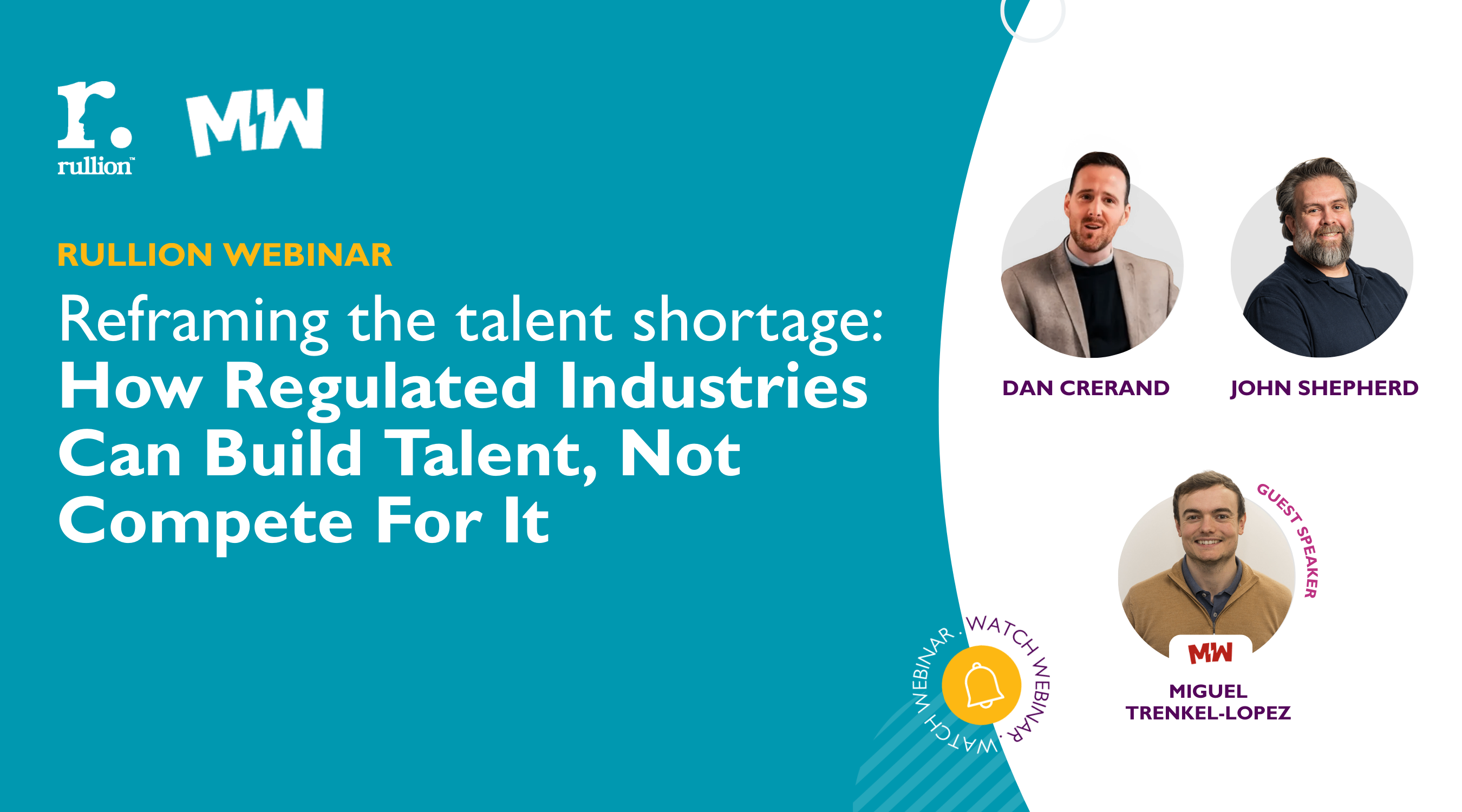
Rullion Webinar

Reframing the Talent Shortage in Regulated Industries Webinar

Webinar | Tuesday 10 March 2026, 13:00 GMT  | 45–60 minutes

<h1>Reframing the Talent Shortage in Regulated Industries Webinar</h1>

Regulated industries are being asked to deliver at pace while operating under increasing levels of scrutiny.

In environments governed by regulators such as the Office for Nuclear Regulation, this tension is already playing out in real workforce decisions.

Across clean energy, electrification, and major infrastructure programmes, delivery pressure is rising as safety and regulatory expectations continue to tighten. In workforce planning conversations, the same conclusion is often reached: there isn’t enough talent.

This session challenges that assumption. We’ll be looking at how Train to Deploy and similar upskilling models are helping organisations prepare people for regulated environments while reducing mobilisation risk.


The issue facing regulated industries is not a lack of people. 

It is an over-reliance on scarcity thinking, where organisations compete for a narrow set of experience profiles instead of building capability in a controlled and compliant way.

During the session, we will explore how organisations are:

pink magnifying glass and person profile

Identifying transferable capability that is often overlooked

Preparing people for regulated environments in a controlled way

Reducing reliance on experience-only hiring models

Building talent pipelines designed around delivery needs

NNB delivery highlights an important reality

Using nuclear new build (NNB) as a real-world delivery context, including programmes such as Sizewell C and Hinkley Point C, this webinar explores how organisations are building regulated capability across complex supply chains.

Nuclear professionalism is required long before any radioactive material is present on site. Much of the capability needed already exists within construction, infrastructure, and engineering, particularly across the supply chain.

What is often missing is not skill, but a structured route into regulated environments.

What you'll take away:

This session will give you a clearer view of how regulated organisations are approaching workforce delivery in practice.

Building capability in regulated environments

Preparing people for nuclear professionalism

Real-world success stories

Unlocking transferable skills in NNB supply chains

Reducing mobilisation risk through upskilling

Answers to your most burning questions (Live Q&A)

Be part of the conversation

Join us on Tuesday 10 March, 1pm GMT

This is a discussion-led session with minimal slides and live questions throughout. If you have a workforce challenge or question, share it when you register. We’ll use it to shape the discussion and answer what matters most to you.

Meet the speakers

Meet your hosts and our guest speaker

Dan Crerand

Train to Deploy Director at Rullion

Dan leads the development of skills-first workforce solutions at Rullion. Since 2023, he has built the Train to Deploy function, working with employers to design structured learning pathways that prepare individuals for regulated and hard-to-fill roles.

His work focuses on unlocking potential through upskilling and building workforce models that are both compliant and commercially effective.

John Shepherd

Client Services Director |  Energy & Utilities at Rullion

John works with organisations across the UK’s nuclear and energy sectors to deliver long-term workforce solutions for regulated environments.

His experience spans major NNB programmes and complex supply chains, with a focus on recognising transferable skills and shifting organisations away from scarcity-led hiring approaches.

Our guest speaker

Miguel Trenkel-Lopez

Founder, Megawatt

We're excited to have Miguel, founder of Megawatt, joining us for this event. Megawatt is a non-profit raising energy literacy through play. Through award-winning resources, Megawatt introduces young people to the energy system and the careers shaping its future.

The skills exist.

The challenge is how we build them.

If you’re delivering work in regulated environments, this session will explore how organisations are building compliant capability across nuclear new build programmes and complex supply chains, rather than competing for the same narrow experience profiles.

What's on your mind?

Our insights and tips on some of your most burning questions

12-Step Guide: Reduce your time-to-hire with the help of a candidate referral scheme

12-Step Guide: Reduce your time-to-hire with the help of a candidate referral scheme

Here’s a 12-step guide on how to reduce your time-to-hire with the help of a candidate referral scheme: Plan and set goals Define clear goals for your referral program. Determine how much you want to reduce the time-to-hire and how many successful hires you aim to achieve through this program. Design the programme Create a well-structured referral program. Decide on the incentives you'll offer to employees who refer successful candidates. These incentives could include monetary rewards, gift cards, extra vacation days, or even a special recognition within the company. Promote the programme Make sure all employees are aware of the referral program. Use company-wide communications, meetings, and emails to inform them about the programme’s benefits and how it can positively impact the hiring process. Provide clear guidelines Offer clear guidelines on the types of candidates you’re looking for and the positions you’re hiring for. This will help employees understand what kind of referrals will be valuable to the company. Simplify the referral process Make the referral process easy and onvenient. Provide an online portal or a simple form where employees can submit referrals along with the necessary information. Engage hiring managers Involve hiring managers in the process. They can provide insights into the skills and qualities they're seeking in candidates, which will help employees make more targeted referrals. Regular updates Keep employees informed about the progress of referred candidates. Send regular updates on the status of the referred candidates’ application and interview process. Timely communication Once a referral is received, promptly communicate with the referred candidate. Speed up the interview process for referred candidates to show the commitment to the programme and keep them engaged. Streamlined interviews Streamline the interview process for referred candidates. If possible, prioritise their interviews to ensure they move through the process quickly. Feedback and recognition Provide feedback to employees who make referrals. Even if the referred candidate isn’t selected, acknowledge the effort, and show appreciation for their contribution. Monitor and measure Continuously monitor the performance of your referral programme. Measure metrics such as time-to-hire, the number of successful referrals, and the quality of hires. Adjust the programme if necessary to achieve better results. Refine the programme Based on the data and feedback you gather, refine the referral programme over time. Adjust the incentives, communication strategies, or guidelines as needed to improve the programme’s effectiveness. By implementing a well-designed candidate referral scheme, you can harness the power of your current employees’ networks to source potential candidates, ultimately speeding up the hiring process and increasing the likelihood of successful hires. Want to find out more? Fill out our contact form below and one of our experts will get back to you.

By Rullion on 07 January 2025

5 Pre-employment Screening Mistakes That Cost You Time, Talent and Trust

5 Pre-employment Screening Mistakes That Cost You Time, Talent and Trust

From prolonged clearance delays to missed hires and poor candidate communication, many organisations don’t realise just how much is going wrong behind the scenes. And when screening is treated as a tick-box admin task or left to automated black-box systems, it’s not just candidates who lose confidence - it’s your projects, your timelines, and your brand. We sat down with Jayne Lee, Head of Candidate Services at Rullion, to uncover the five most common screening mistakes she sees every week. Plus, what a better, faster, human-led approach really looks like. Why Screening Is More Than a Tick-Box Exercise Too many employers treat pre-employment screening as a box-ticking chore, something to be automated, outsourced on the cheap, or buried within already-stretched HR functions. But the stakes are far higher than most realise. "Candidates are left hanging for 40 days, sometimes six months. Clients can’t get people on-site. Everyone’s frustrated, and nobody wins." — Jayne Lee Screening is not just about compliance. It’s about trust, operational readiness, and safeguarding your organisation’s brand. When mishandled, it can stall entire projects, drive away top talent, and leave teams critically understaffed. What Happens When Screening Goes Wrong In Jayne’s world, horror stories abound: candidates ghosted by automated systems, clients left to chase their own references, and six-month clearance times that sabotage even the best-laid hiring plans. From a compliance perspective, that’s risky enough. But the real cost comes in the form of: Delays to mobilisation and project timelines Lost candidates, who accept faster offers elsewhere Frustrated hiring managers, stuck in limbo Reputational damage, as candidate experience deteriorates Jayne describes a common tale: a company chooses a low-cost provider based purely on price. Within a year, they get burned by red-amber-green status updates and incomplete checks, but still charged full fees. It’s a classic example of how lower-cost options can lead to higher costs over time. What seems cheaper upfront often results in greater expense later. — Jayne Lee Top 5 Screening Mistakes to Avoid Choosing a provider based purely on price Relying on automated systems with no human oversight Treating screening as an afterthought in the hiring process Failing to update candidates during delays Underestimating the reputational cost of poor candidate experience The Four Pillars of a Good Screening Process So what does good look like? According to Jayne, the best pre-employment screening services share four key traits: 1. Speed Rullion averages just 7–8 days for full clearances. That’s no accident. It’s the result of a dedicated team, proactive communication, and structured workflows. 2. Accuracy Accuracy isn’t negotiable. Cutting corners increases risk and invites compliance breaches. 3. Candidate Experience Each candidate is assigned an advisor who guides them through the process, no faceless systems or ticket queues. This human-led approach builds trust and keeps things moving. 4. Compliance Especially in safety-sensitive sectors, clearances like BPSS must be handled to exacting standards. "Our advisors don’t just send emails - they know who to call, when to push, and how to escalate." — Jayne Lee Trends and Challenges in Screening Today Screening is evolving, and fast. Jayne highlights three major shifts: Growing regulation: in sectors like nuclear, utilities, and transport Automation that helps: but can’t replace - human expertise Rising candidate expectations: for fast, clear communication Many organisations are entering regulated sectors for the first time, unaware of what secure screening services really involve. Others rely on overburdened HR teams, hoping for the best. "Screening is often a homeless task. Nobody owns it, and it bounces from admin to HR until something breaks." — Jayne Lee How to Choose the Right Screening Partner If you’re in a high-stakes environment, the right screening partner isn’t a nice-to-have, it’s essential. Here’s what to look for: Specialist knowledge: of your sector and its compliance demands Technology that supports: not replaces, human interaction Transparent processes: clear SLAs, and real-time tracking Full ownership: so you’re never left to finish an incomplete check And most importantly, speed and service shouldn’t be trade-offs. Jayne’s team delivers both. "When I speak to ops teams, they get it immediately - they’re living the nightmare. Procurement? Not always." — Jayne Lee Screening Is a Strategic Advantage Screening isn’t a formality. It’s the critical bridge between offer and start date. It’s one that protects your operations, ensures compliance, and strengthens your brand. As Jayne says, when done right, pre-employment screening isn't just faster and safer, it’s smarter. So if you're still stuck in the red-amber-green trap, it might be time to rethink your approach.

By Rullion on 31 July 2025

5 Signs Your Workforce Needs a Train to Deploy Strategy

5 Signs Your Workforce Needs a Train to Deploy Strategy

You need a Train to Deploy Strategy when you find yourself: Rehiring the same roles repeatedly Staring down a retirement cliff Watching time-to-hire stall delivery Falling behind on diversity and social value Working with out of sync training providers Train to Deploy, often referred to as a Hire Train Deploy or a Recruit Train Deploy model, is a workforce transformation solution where a provider designs, delivers, and deploys role-specific training up front, helping you plug skills gaps, onboard faster, and build work-ready teams from day one. This is typically done by bringing in transferable talent from adjacent sectors, reskilling deployed contractors, or hiring and training new external candidates aligned with your business goals. Most organisations don’t always realise when they’re ready for a Train to Deploy (TTD) strategy. The signs build gradually. Recruitment pressures intensify quietly. Talent pools shrink. Skills gaps start to feel permanent. And the tools that once worked – your job boards, agencies, and graduate deployment schemes – no longer deliver the talent or speed you need. If any of this feels familiar, you're not without options. A Train to Deploy strategy can help you rebuild confidence in your workforce plan, expand your reach, and reduce the hidden costs of reactive hiring. It’s one of the most effective ways to evolve your talent pipeline strategy to build scalable, work-ready teams. Here are five signs that now might be the right time to make the shift. 1. You’re Rehiring the Same Roles Repeatedly When roles start to become revolving doors, it’s often a sign that the problem isn’t just recruitment; it’s readiness. High turnover in key positions can point to poor role fit, lack of structured development, or unclear progression pathways. It burns through recruitment budgets, disrupts project continuity, and stalls long-term growth. TTD flips the traditional model on its head. Instead of waiting for the “right” person to appear, you develop the capabilities you need within the people you hire or redeploy from day one. Rullion’s match-to-train approach directly addresses the root cause by designing role-specific training and onboarding ahead of deployment, ensuring the people coming into your organisation are better equipped, aligned, and more likely to stay. You’re building the talent you need, sustainably. 2. You’re Staring Down a Retirement Cliff In critical infrastructure sectors, retirements are accelerating. In the UK energy and utilities sectors alone, 37% of the workforce will retire by 2030 – that’s around 168,400 vacancies that will need to be filled. And with them, decades of knowledge are walking out the door. Our train and deploy solution bridges that gap before it opens. We help you upskill successors, build structured handovers, and onboard people who can shadow, learn, and grow into critical roles. We make sure that expertise isn’t lost. It’s transferred, evolved, and retained. 3. You’re Watching Time-to-Hire Stall Delivery Every week you wait for a hire to land is a week your teams aren’t delivering. In project-based environments, those delays cascade into missed milestones, overstretched teams, and lost momentum. A Hire Train Deploy strategy eliminates that lag. With custom training and onboarding ahead of deployment, candidates arrive equipped with the technical and behavioural readiness to contribute from day one. That upfront investment in preparation pays dividends in retention, and not just in performance. When new hires feel supported, skilled, and set up to succeed, they’re far more likely to stay. 4. You’re Falling Behind on Your Diversity and Social Value Goals Most organisations have diversity targets and social value commitments, but traditional hiring often reaches the same narrow pools in the same ways. Rullion’s Train to Deploy solution is built around inclusion without limits. If someone shows the right mindset, behaviours, and potential, we build the skillset, regardless of their background or circumstance. We don’t tick boxes or run generic ED&I programmes. We focus on opening doors to those with potential and create genuinely inclusive talent pipelines that reflect the communities you serve. 5. Your Training Providers Feel Out of Sync As your organisation adapts to new technologies, delivery models, and regulatory changes, you need learning partners that can evolve just as fast. But many traditional training providers are slow to respond. Courses feel outdated, generic, or disconnected from the realities your teams face day-to-day. This disconnect leads to wasted investment, delayed impact, and talent that still isn’t ready for the job. If your current provision feels out of sync, Rullion’s Train to Deploy strategy gives you control. You co-design the training journey to reflect your systems, tools, and standards, and we manage delivery, acting as the conduit between you and the training providers. We help embed learning into your operating model, whether through bespoke external programmes or scaling your own internal training. Making sure your people are learning what matters and applying it from day one. Recognising the Signs Every workforce challenge is an opportunity to rethink the way things have always been done. If any of these signs sound familiar, it may be time to reassess your approach. A Train to Deploy strategy offers a more proactive path, helping you build the skills, teams, and resilience you need to grow. Shift from reactive hiring to long-term capability building. And get ahead of change before talent gaps hold you back. Helping you get work done Visit our Train to Deploy solution page to see how a Train to Deploy strategy could work for your organisation or book a discovery call with one of our consultants.

By Rullion on 21 July 2025