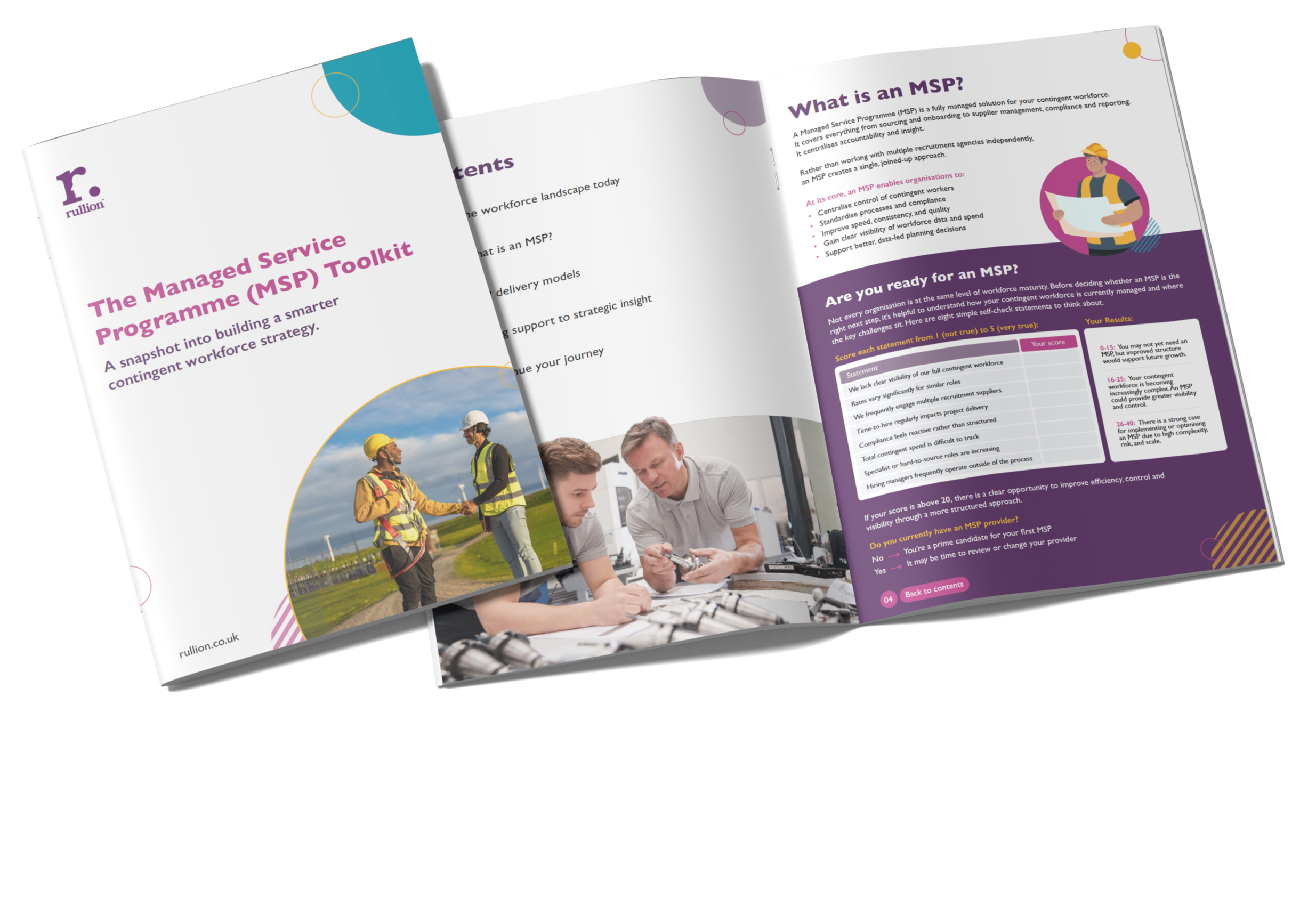
A snapshot into our practical MSP guide

Take a look inside our Managed Service Programme toolkit.

This snapshot gives you a quick, practical starting point for shaping a smarter temporary workforce strategy, with examples and thinking grounded in the realities of the Nuclear, Energy, Rail, and Utilities industries.

<h1>A snapshot into our practical <span style="color: #bd3383;">MSP guide</span></h1>

Built for procurement, HR, and workforce leaders. Updated for organisations delivering across today’s critical infrastructure landscape.

If you’re exploring a managed service programme for the first time (or wondering if your current MSP approach is fit for purpose), this snapshot gives you a clear place to start.

It’s designed for teams balancing compliance, pace of delivery, and specialist skill demand, where contingent labour plays a critical role in keeping projects moving and services running.


The MSP essentials covered in this guide

  • The contingent workforce landscape today and what’s changing across critical infrastructure
  • What an MSP in recruitment is, and how it elevates beyond transactional recruitment
  • Common delivery models and what to consider when choosing an MSP approach

Inside the complete toolkit

The full MSP toolkit goes deeper into cost, value, and implementation, with practical frameworks to help you build your case and move from reactive hiring to measurable workforce insight.

  • Understanding MSP costs, business value, and ROI drivers
  • Real-world outcomes from organisations like yours
  • Building your business case for change
  • A practical 90-day plan to get started
  • What the future of contingent workforce looks like

Explore frameworks designed for regulated, delivery-critical environments

This guide is only the beginning. The full MSP toolkit helps you move from early thinking to execution, with a complete business case framework, practical implementation guidance, and insights drawn from critical infrastructure delivery. You can also speak to our team about what approach works best for your organisation.

What's on your mind?

Our insights and tips on some of your most burning questions

NEWS
Managing umbrella company compliance in 2026 with real-time workforce monitoring

Managing umbrella company compliance in 2026 with real-time workforce monitoring

From 6th April 2026, new PAYE rules introduced by HM Revenue and Customs (HMRC) will change how tax responsibility is distributed across labour supply chains that use umbrella companies. Where PAYE is not handled correctly, HMRC will be able to recover unpaid tax from other parties in the chain, including recruitment agencies and, in some cases, end clients, too. With responsibility no longer sitting solely with the payroll provider, this places greater importance on having clear oversight of your umbrella company compliance and wider contingent labour supply chain. The complex delivery models and layered supply chains in critical infrastructure environments like rail and energy typically make visibility more difficult to maintain, placing even more emphasis on maintaining oversight and reducing umbrella company compliance and labour supply chain risk. Point-in-time checks no longer provide enough assurance Many compliance frameworks are still built around periodic review. This usually relies on onboarding checks and periodic audits, with supporting documentation provided by the supplier. These approaches provide a snapshot of compliance at a specific moment. They do not reflect how umbrella payroll operates on an ongoing basis. Payments are processed continuously, and changes within the supply chain can take place between review points without being visible.This creates a gap between what has been confirmed via the periodic review and what is actually happening in your live environment. When issues are identified later, organisations are often relying on information that no longer reflects current activity.Industry guidance from organisations such as the Recruitment and Employment Confederation and Association of Professional Staffing Companies has increasingly highlighted the need for stronger oversight of labour supply chains. The expectation is shifting towards being able to demonstrate how compliance is maintained over time, supported by current and verifiable data. Rullion’s approach to labour supply chain compliance Rullion has taken a structured approach to strengthening oversight across its labour supply chain, with a focus on embedding compliance and ongoing oversight into wider processes rather than treating it as a separate activity. This includes enhanced due diligence when engaging umbrella providers, alongside clearer governance around how those providers are monitored over time. The aim is to maintain a consistent and current view of the supply chain, with visibility that reflects day-to-day operations. As part of this approach, Rullion has implemented SafeRec Plus to support visibility into umbrella payroll activity. The platform provides access to live payroll data in real time, alongside cross-referencing with HMRC submissions through real-time information. It also supports ongoing oversight of umbrella providers, with financial monitoring and evidence capture that can be used to support compliance reporting. Having this access to current data allows payroll activity to be reviewed as it takes place, supporting a more informed approach to governance and reducing reliance on retrospective checks. This also supports Rullion’s managed contingent workforce solutions, such as managed service programmes (MSP) and Statement of Work (SoW) models, where consistent oversight across multiple suppliers is required to maintain control and reduce risk at scale. Improving umbrella payroll visibility For organisations using umbrella companies, the ability to access and review current payroll data provides a clearer understanding of how workers are being paid and taxed within the supply chain. This level of visibility supports more informed decision-making when engaging and managing suppliers. It also reduces the likelihood of issues going unnoticed, particularly across nuclear infrastructure supply chains where there are thousands of contractors and multiple delivery partners involved. Supporting internal governance and audit requirements Greater visibility across umbrella payroll activity also supports internal governance processes. Compliance, procurement, and finance teams are increasingly expected to understand how contingent labour is engaged with and managed. This includes being able to review supplier arrangements and assess whether they meet both internal standards and regulatory expectations. Access to verifiable, up-to-date information allows these teams to carry out that role more effectively, without relying solely on historic checks or supplier assurances. A more established direction for compliance Across the recruitment sector, there is a shift towards more structured oversight of umbrella supply chains. This is reflected in how organisations are reviewing their supplier models. Greater attention is being given to how umbrella companies operate, how consistently they are monitored, and how easily that activity can be understood when required. This is also influencing how suppliers are assessed, with more weight placed on the ability to provide clear and accessible information about payroll processes and compliance. While this level of oversight is not yet the norm across the market, it is becoming more widely expected. Organisations are placing greater emphasis on transparency and control, particularly where supply chains are complex or operate within regulated environments. As labour supply chain compliance continues to evolve as regulation and enforcement develop, maintaining visibility across umbrella agreements will remain an important part of managing risk. This includes understanding how payroll is handled and how compliance is monitored, with evidence available when required. Ongoing oversight is becoming a more established part of how labour supply chain risk is managed. For organisations operating in regulated environments, particularly nuclear infrastructure and utilities companies, maintaining a clear and current view of how their workforce is engaged and paid is increasingly becoming a standard expectation rather than an additional compliance step.

By Rullion on 07 April 2026

NEWS
Rullion strengthens fusion presence with Culham Campus office

Rullion strengthens fusion presence with Culham Campus office

Rullion has relocated its Fusion team to a new office at Culham Campus, strengthening its presence at the centre of the UK’s fusion community. The team has long supported organisations based at Culham, but establishing a new home on campus marks a deeper commitment to the fusion sector. As the site continues to grow as a hub for fusion research, technology development, and commercial collaboration, being embedded within that environment enables closer working relationships across the wider fusion ecosystem, including organisations such as the UK Atomic Energy Authority (UKAEA). John Shepherd, Client Services Director, shared his perspective on strengthening Rullion’s presence at the heart of the fusion sector: “Culham Campus sits at the centre of the UK’s fusion community. Having our team based here reflects how important it is to work alongside the organisations driving this technology forward. Fusion represents a major opportunity for the future of energy, and delivering it will depend on building a workforce with highly specialised skills. Our role is to support that growth by connecting organisations with the talent they need, both in the UK and internationally.” Rullion is a proud member of the Fusion Skills Council and continues to play an active role in addressing the workforce demands facing the sector. As fusion moves from research into increasingly complex engineering and commercial programmes, access to specialist capability is becoming more significant. The team supports both contingent hiring and permanent hiring across highly technical disciplines, including: Plasma Physicists Tritium Fuel Cycle Engineers Cryogenics Consultants Tokamak specialists Robotics Engineers Alongside this, Rullion has expanded its international recruitment capability, supporting global mobility and bringing expertise to the UK where it is needed. This enables fusion organisations to access talent from established scientific and engineering markets including: Australia France Italy Switzerland By basing the team at Culham Campus, Rullion is reinforcing its position as a leading recruitment partner within the fusion sector and strengthening the relationships that will shape the next phase of fusion energy development.

By Rullion on 04 March 2026

NEWS
Rullion Named in the UK’s Top 20 Largest Staffing Firms by SIA

Rullion Named in the UK’s Top 20 Largest Staffing Firms by SIA

Rullion has been named by Staffing Industry Analysts (SIA) as one of the 20 largest staffing firms in the UK, recognising the scale of our role as a leading recruitment and workforce solutions provider nationwide and across Europe. The annual ranking places Rullion alongside the country’s leading providers supporting organisations with complex hiring and workforce challenges. Across critical infrastructure sectors including energy, nuclear, rail, and utilities, Rullion works in partnership with organisations to build and manage skilled project teams and wider workforce programmes that support long-term delivery. This can range from scaling engineering capability for major capital projects to overseeing managed service models that bring structure and consistency to high-volume hiring. Rullion’s services span permanent recruitment, temporary recruitment, and managed workforce solutions, including MSP and RPO models that support organisations through periods of transformation and long-term infrastructure investment. By combining sector expertise with flexible workforce delivery, Rullion helps clients improve workforce planning and strengthen access to scarce skills, all while maintaining continuity across complex national programmes. “This recognition reflects the work our teams do every day alongside our customers delivering critical infrastructure across the UK and Europe. The challenges our clients face require deep sector understanding and workforce solutions that adapt as projects evolve. Being named among the UK’s largest staffing firms is a result of the strong partnerships we’ve built and the practical, high-quality recruitment support we continue to deliver.” – Lindsay Harrison, Chief Customer Officer The SIA ranking provides independent recognition of Rullion’s continued growth as a workforce solutions provider supporting organisations responsible for some of the UK’s most important infrastructure programmes.

By Rullion on 26 February 2026